
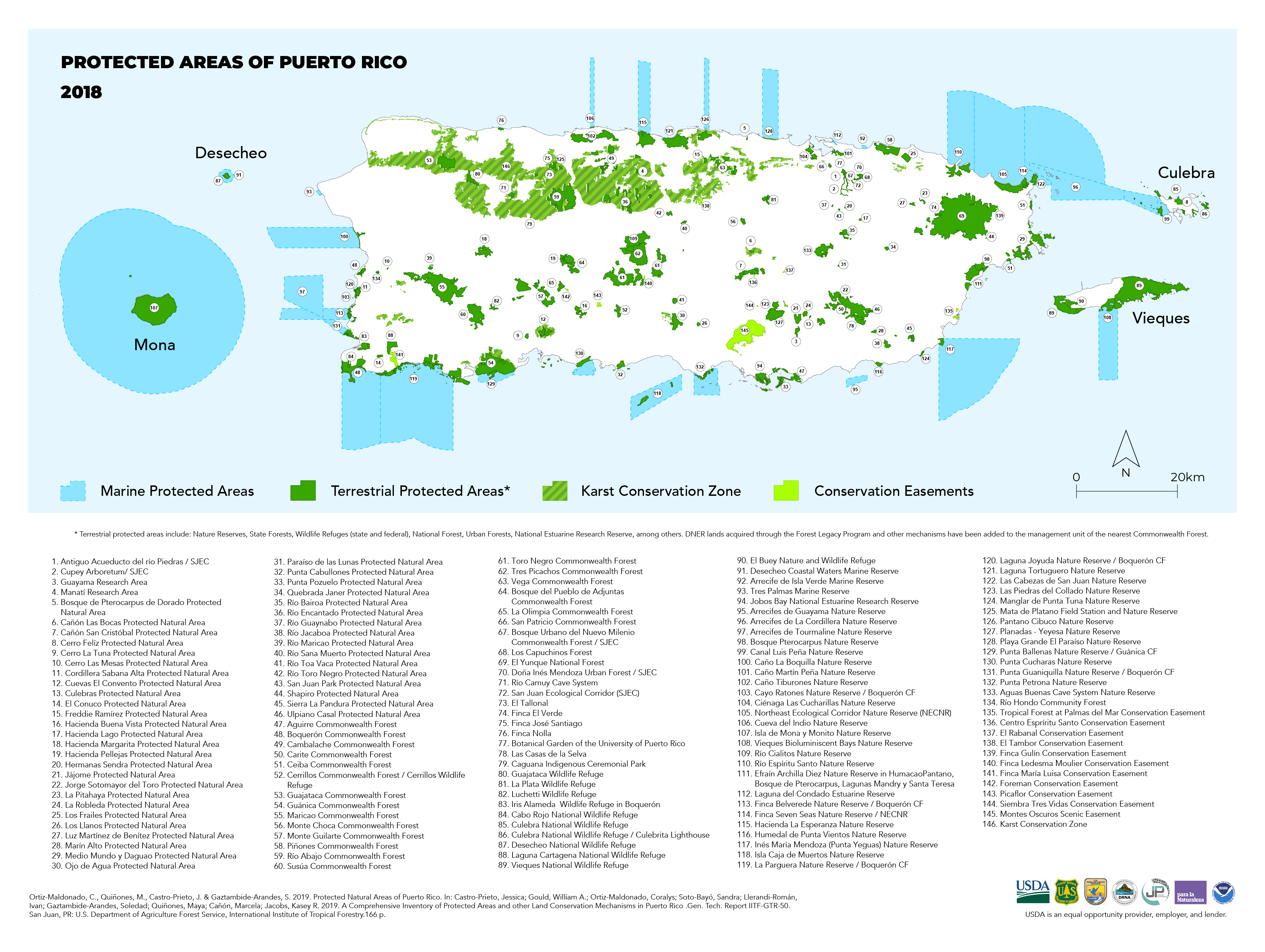
Puerto Rico has a variety of ecosystems that are unique in the Caribbean. These natural environments are of great ecological, economic, social and educational attraction. Some of them we know very well, such as the Yunque National Forest or the Camuy Caves, but do we really know how many natural areas are protected? To answer that question we must first know what a natural protected area is, how they are classified and what are the criteria for designating them. According to the Puerto Rico Protected Areas Conservation Action Team, a natural protected area is a geographically defined space for the long-term conservation of biodiversity, cultural values and ecosystem services. It sounds complicated, but basically these areas benefit society.
www.fs.usda.gov/Internet/FSE_MEDIA/fseprd667185.png
Puerto Rico currently has 16% of natural terrestrial areas and 26% of natural marine protected areas. These are divided into the following categories: State Forests, Nature Reserves (Estuarine Reserves and Marine Reserves) and Wildlife Refuges.
What criteria are evaluated for a natural area to be protected?
It must be a place of high ecological and cultural value and of vulnerable character, as well as being the habitat of a species in danger of extinction.

Punta Tuna Natural Reserve, Maunabo PR. Photo by DRNA Puerto Rico.
They are managed by different state and federal agencies, non-governmental organizations, and others. These agencies are responsible for the management, protection and conservation of these areas in order to promote the enjoyment of these resources for future generations. However, Puerto Rico has a low percentage of protected natural areas, which brings us to the country's environmental public policy and how these laws and regulations are being managed to perpetuate the spaces that are not designated as protected areas. It is of the utmost importance to protect our natural resources by implementing laws, management plans, regulations etc. These mechanisms help the conservation of these environments that have an important educational, recreational, ecological and research value for our island. We must emphasize the benefits that the protected natural areas provide to the species that use these spaces as habitats, food sources and reproduction. The natural resources of Puerto Rico are unique and we all have a duty to encourage the conservation and protection of these, whether through education, citizen effort or the administrative sphere.
About the Author:
Nicole Merced Robles
She is a 7th-12th grade science teacher and a master's student in Environmental Management at the Ana G. Méndez University (UAGM) Cupey campus. Her favorite hobbies are: reading, giving talks and workshops, traveling, going to the beach and exercising.